Mangrove Community Structure on the Coast of Tomini Bay, Boalemo Regency, Gorontalo Province
DOI:
https://doi.org/10.46252/jsai-fpik-unipa.2025.Vol.9.No.4.550Keywords:
Mangrove, density, frequency, dominance, Tomini BayAbstract
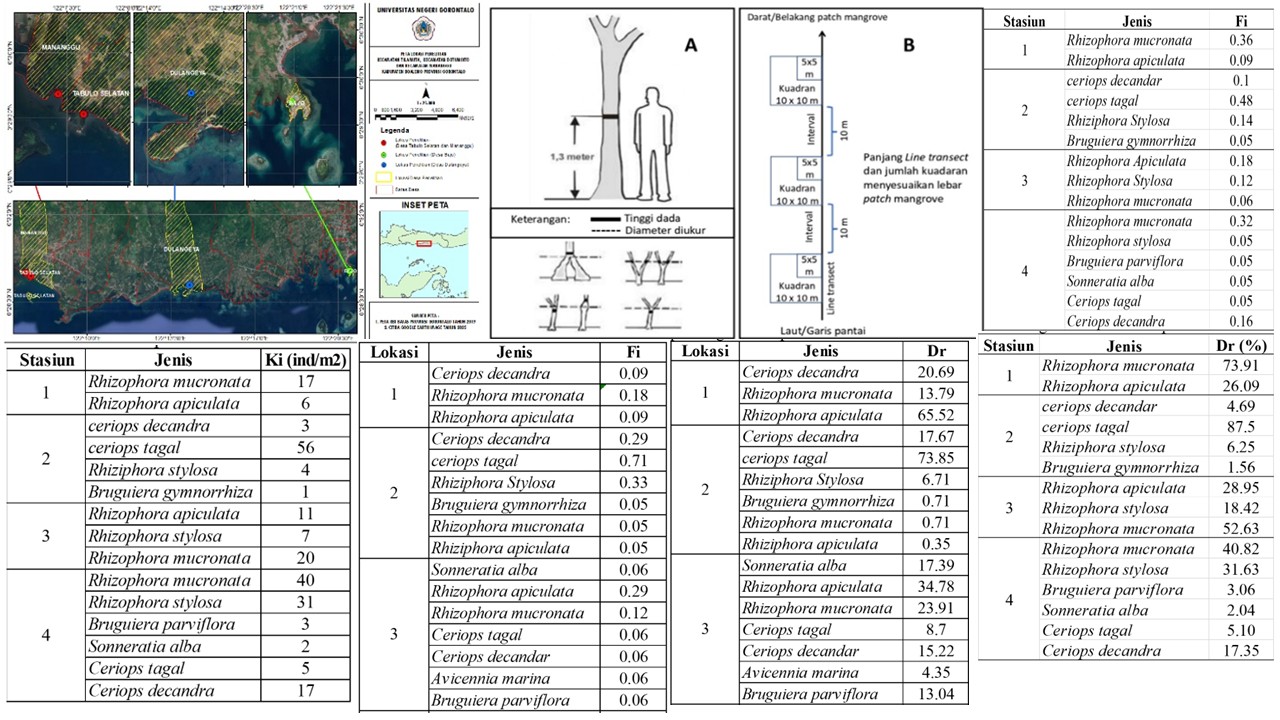
Mangroves are coastal ecosystems, especially in tropical areas including Tomini Bay, Gorontalo Province. Mangrove ecosystems not only function as coastal abrasion barriers, natural protection from ocean waves, but also as plants that are beneficial to human life, especially for coastal communities. . This study aimed to identify and analyze the structure of mangrove communities on the coast of Tomini Bay, Boalemo Regency, Gorontalo Province. Data collection was carried out using the line transect method at four observation stations for the seedling and sapling categories., then analyzed to determine the absolute density, absolute frequency, and dominance of species. Mangroves found in Tomini Bay, Boalemo Regency from the four stations consist of A. marina, B. gymnorhiza, B. parviflora, C. decandra, C. tagal, R. apiculata, R. mucronata, R. stylosa, S. alba, S. caseolaris, X. moluccensis. In the seedling category, the C. tagal mangrove species at station 2 (Dulangeya Village) showed the highest value in Boalemo Regency, with an absolute density of 56 ind/m², an absolute frequency of 0.48, and a relative dominance of 87.5%. On the other hand, the B. gymnorhiza species recorded the lowest value compared to all observation stations in Boalemo Regency, with an absolute density of only 1 ind/m², an absolute frequency of 0.05, and a relative dominance of 1.56%. The C. tagal mangrove sapling category at station 2 (Dulangeya Village) had the highest absolute density, absolute frequency, and relative dominance in Boalemo Regency, at 8.36 ind/m2 and 0.71 and 73.85, respectively. R. apiculata had the lowest density of all stations in Boalemo Regency, at 0.04 ind/m2 and 0.05 and 0.35, respectively
Downloads
References
Alongi, D. M. (2009). The Energetics of Mangrove Forests. In Austral Ecology (Vol. 36, Issue 5). https://doi.org/10.1111/j.1442-9993.2010.02190.x
Alongi, D. M. (2014). Carbon cycling and storage in mangrove forests. Annual Review of Marine Science, 6, 195–219. https://doi.org/10.1146/annurev-marine-010213-135020
Alongi, D. M. (2018). Impact of global change on nutrient dynamics in Mangrove Forests. Forests, 9(10), 1–13. https://doi.org/10.3390/f9100596
Baderan, D. W. K., Hamidun, M. S., Lamangandjo, C., & Retnowati, Y. (2015). Diversifikasi Produk olahan Buah Mangrove Sebagai Sumber Pangan Alternatif Masyarakat Pesisir Toroseaje, Kabupaten Pohuwato, Provinsi Gorontalo. PROS SEM NAS MASY BIODIV INDON, 1(2), 347–351. https://doi.org/10.13057/psnmbi/m010230
BPS. (2016). Statistik Lingkungan Hidup Indonesia. In Badan Pusat Statistik.
Dabalà, A., Dahdouh-Guebas, F., Dunn, D. C., Everett, J. D., Lovelock, C. E., Hanson, J. O., Buenafe, K. C. V., Neubert, S., & Richardson, A. J. (2023). Priority areas to protect mangroves and maximise ecosystem services. Nature Communications, 14(1), 1–14. https://doi.org/10.1038/s41467-023-41333-3
Damanik, R., & Djamaludin, R. (2012). Atlas Mangrove TELUK TOMINI. In R. Lindayati (Ed.), Program SUSCLAM. https://doi.org/10.1016/s2667-0267(23)00003-6
Fachrul, M.F., 2007, Metode Sampling Bioekologi, Bumi Aksara, Jakarta.
Hastuti, E. D., & Hastuti, R. B. (2016). Analisis Hubungan Suhu Air dengan Mortalita itas Semai Mangrove pada Tambak Wanamina. Prosiding Seminar Nasional from Basic Science to Comprehensive Education, 11–15.
Hayati, S. D., Bramasta, D., Kamala, N., & Basrowi, M. (2021). Floristic Composition and Vegetation Structure in The Edge Forest, Mount Ciremai National Park, West Java. Jurnal Sumberdaya HAYATI, 7(1), 17–24. https://journal.ipb.ac.id/index.php/sumberdayahayati
Indriyanto. (2006). Ekologi Hutan. Bumi Aksara. Jakarta. 138 hal
Kusmana, C. (2014). Peranan Ekosistem Mangrove bagi Pertahanan dan Keamanan NKRI. Bogor (ID): Institut Pertanian Bogor
Matatula, J., Poedjirahajoe, E., Pudyatmoko, S., & Sadono, R. (2019). Keragaman Kondisi Salinitas Pada Lingkungan Tempat Tumbuh Mangrove di Teluk Kupang,NTT. Jurnal Ilmu Lingkungan, 17(3), 425. https://doi.org/10.14710/jil.17.3.425-434
Moha, Y., Any Bay, M. K., Sentia, S., & Kasim, F. (2022). Analisis kondisi eksisting struktur komunitas mangrove Kawasan Pesisir Bolihutuo Kabupaten Boalemo Provinsi Gorontalo. Acta Aquatica: Aquatic Sciences Journal, 9(2), 65. https://doi.org/10.29103/aa.v9i2.8122
Nauta, J., Lammers, C., Lexmond, R., Christianen, M. J. A., Borst, A., Lamers, L. P. M., van Lavieren, H., Naipal, S., & Govers, L. L. (2023). Habitat complexity drives food web structure along a dynamic mangrove coast. Marine Pollution Bulletin, 196(September), 115597. https://doi.org/10.1016/j.marpolbul.2023.115597
Noor, R., Y., M. K., & Suryadiputra, I. N. N. (2006). Pengenalan Mangrove di Indonesia (Cetakan Ke). PHKA/WI-IP.
Prihandana, P. K. E., Putra, I. D. N. N., & Indrawan, G. S. (2021). 62947-1664-202263-1-10-20210312. 4(1), 29–36.
Priyono, A. (2010). Panduan Praktis Teknik Rehabilitasi Mangrove di Kawasan Pesisir Indonesia. Semarang: Kesemat
Puryono, S. K. (2006). Uji Coba Penanaman Mangrove di Bekas Tambak Budidaya Udang di Kabupaten Pemalang. In Jurnal Litbang Provinsi Jawa Tengah (Vol. 4, Issue 2, pp. 98–103).
Rahmi, S., Rustam, & Kamil. (2025). Struktur Vegetasi Mangrove Berdasarkan Tekstur Substrat Didusun Sabang Desa Bonto Bahari Kecamatan Bontoa Kabupaten Maros. Mangrove Vegetation Structure Based on Substrate Texture in Sabang Hamlet, Bonto Bahari Village, Bontoa District, Maros Regency. Jurnal Ilmiah Wahana Laut Lestari, 2(2), 167–179.
Ramena, G. O., V Wuisang, C. E., & P Siregar, F. O. (2020). Pengaruh Aktivitas Masyarakat Terhadap Ekosistem Mangrove Di Kecamatan Mananggu. Jurnal Spasial, 7(3), 343–351.
Sanadi, S., Tampubolon, N., Widiastuti, N., Simatauw, Fanny, F. ., Bato, M., & Duwit, B. (2023). Analisis Vegetasi Mangrove di Kelurahan Bonkawir Kota Waisai Kabupaten Raja Ampat. Jurnal Sumberdaya Akuatik Indopasifik, 7(2), 201–214.
Soeprobowati, T. R., Anggoro, S., Puryono, S., Purnaweni, H., Sularto, R. B., & Mersyah, R. (2022). Species Composition and Distribution in the Mangrove Ecosystem in the City of Bengkulu, Indonesia. Water (Switzerland), 14(21). https://doi.org/10.3390/w14213516
Soria-Barreto, M., Pérez-Ceballos, R., Zaldívar-Jiménez, A., & Fernández, R. G. (2023). Assessment of aquatic food web and trophic niche as a measurement of recovery function in restored mangroves in the Southern Gulf of Mexico. PeerJ, 11, 1–28. https://doi.org/10.7717/peerj.15422
Sraun, M., Bawole, R., Marwa, J., Sinery, A. S., & Cabuy, R. L. (2022). Diversity, composition, structure and canopy cover of mangrove trees in six locations along Bintuni riverbank, Bintuni Bay, West Papua, Indonesia. Biodiversitas, 23(11), 5835–5843. https://doi.org/10.13057/biodiv/d231137
Suryaperdana, Y., Soewardi dan A. Mashar. 2012. Keterkaitan lingkungan mangrove pada produksi udang dan ikan bandeng di kawasan silvofishery Blanakan, Subang, Jawa Barat. Bonorowo Wetlands, 2(2): 74-85.
Thalib, M., Baderan, D. W. K., & Katili, A. S. (2021). Produksi dan Laju Dekomposisi Serasah Ceriops tagal di Cagar Alam Tanjung Panjang (The Production and Decomposition Rate of Ceriops tagal Litter in Tanjung Panjang Nature Reserve). Jurnal Sylva Lestari, 9(1), 151–160. https://doi.org/10.23960/jsl19151-160
Ulyah, F., Hastuti, E. D., & Prihastanti, E. (2022). Struktur Komunitas Vegetasi Mangrove Di Pesisir Pantai Kepulauan Karimunjawa. Jurnal Ilmu Lingkungan, 20(1), 176–186. https://doi.org/10.14710/jil.20.1.176-186
Wambrauw (2017). Struktur Vegetasi Mangrove Serta Pemanfaatannya Oleh Masyarakat Pesisir Kampung Yenusi Distrik Biak Timur Kabupaten Biak Numfor. Skripsi pada Program Studi Manajemen Sumberdaya Perairan. Universitas Papua.
Wantasen, A. S. (2013). Kondisi Kualitas Perairan Dan Substrat Dasar Sebagai Faktor Pendukung Aktivitas Pertumbuhan Mangrove Di Pantai Pesisir Desa Basaan I , Kabupaten Minahasa Tenggara Conditions of Substrate and Water Quality Supporting Activites as A Gro. Jurnal Ilmiah Platax, 1(September), 204–209.
Wardhani, M. K. (2014). Conformity Analysis of Mangrove Forest of Conservation Land in South Coast of Bangkalan Regency. Jurnal Kelautan, 7(2). http://journal.trunojoyo.ac.id/jurnalkelautan
Yuliana, D., et al. (2019). Komposisi dan Struktur Vegetrasi Mangrove di Pesisir Sulawesi Tengah. Jurnal Ilmu Kelautan Tropis
Downloads
Published
How to Cite
Issue
Section
License
Copyright (c) 2025 Fauzia Zees, Rieny Sulistijowati, Lukman Mile

This work is licensed under a Creative Commons Attribution-ShareAlike 4.0 International License.